
About aikido
A martial art of blending, balance and harmony
The art
Aikido (合気道) is a Japanese martial art. The name is made of three characters: ai, harmony or joining; ki, energy or spirit; and do, the way. It is often translated as "the way of harmonizing energy."
Rather than meeting force with force, an aikido student learns to move off the line of an attack, join with its energy and redirect it, ending in a throw or a pin. Good technique depends on timing, posture and relaxed power, not on size or strength, which is why people of very different builds and ages can train together.
There are no tournaments or winners in aikido. The goal is to resolve a conflict with as little harm as possible, to the attacker as well as to yourself. Many students find that this way of thinking carries over into everyday life: staying calm under pressure, keeping your balance, and dealing with difficult situations without escalating them.
The founder
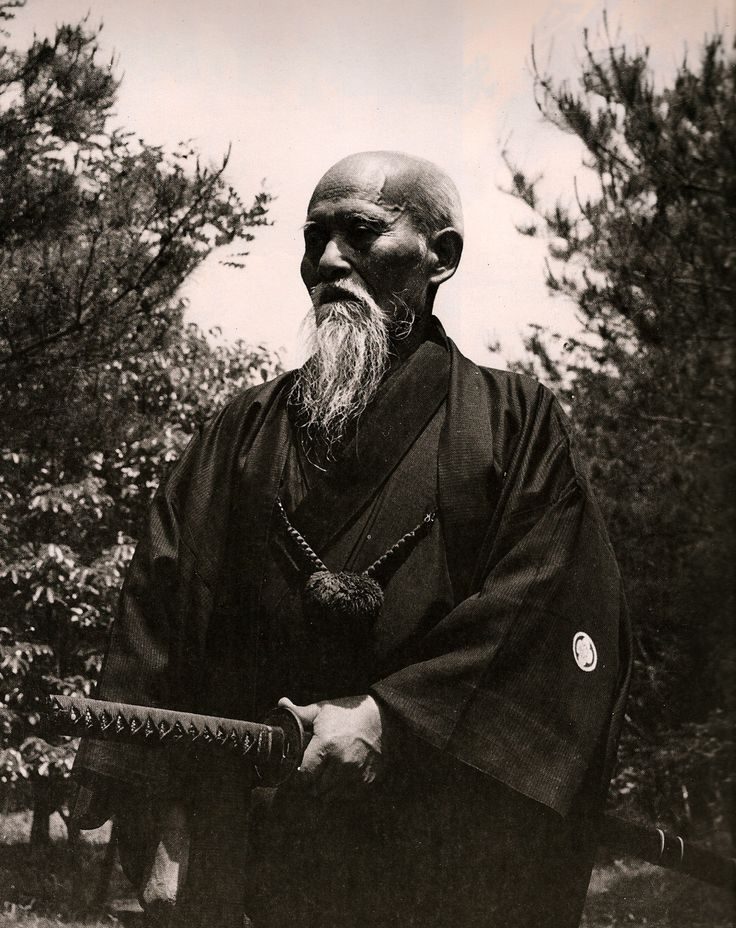
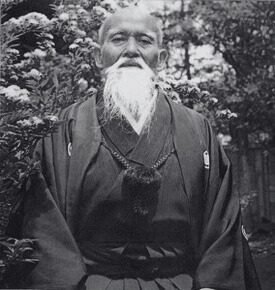
Morihei Ueshiba, often referred to as O-Sensei, meaning "Great Teacher," was born on December 14, 1883, in Tanabe, Wakayama Prefecture, Japan. From an early age, Ueshiba showed a keen interest in martial arts, driven by his desire to overcome physical weakness and protect himself and others. He pursued rigorous training in several martial arts, including jujutsu, kenjutsu, and sojutsu, honing his skills and expanding his understanding of martial techniques and philosophies.
In the early 20th century, Ueshiba became deeply influenced by the teachings of Onisaburo Deguchi, the spiritual leader of the Omoto-kyo religion. This spiritual journey led him to integrate profound philosophical and ethical principles into his martial practice. It was during this time that Ueshiba began to develop the foundations of aikido, a martial art focused on harmony, peace, and the redirection of an opponent's energy rather than brute force.
Aikido, which means "the way of harmonizing energy," was officially founded by Ueshiba in the 1920s. He continued to refine and teach the art throughout his life, establishing the Aikikai Foundation and the Hombu Dojo in Tokyo as the central headquarters for the Aikido practice. Ueshiba's aikido emphasized the importance of blending with an attack and using circular movements to neutralize aggression, making it unique among martial arts for its focus on non-violent conflict resolution.
Morihei Ueshiba's legacy extends beyond the technical aspects of aikido. He is remembered for his profound spiritual teachings, emphasizing the unity of mind, body, and spirit. His vision of Aikido as a means of fostering peace and understanding among people has inspired countless practitioners worldwide. O-Sensei's life and creation of aikido continue to be celebrated for their contributions to both the martial arts community and the broader quest for harmony in human interactions.
How aikido is practiced
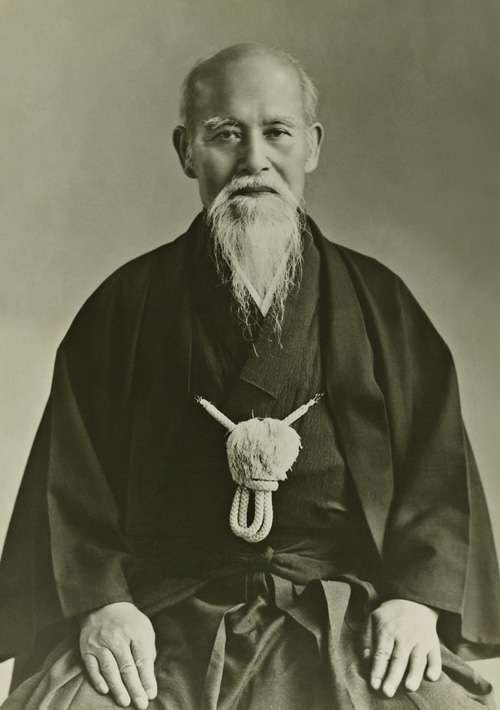
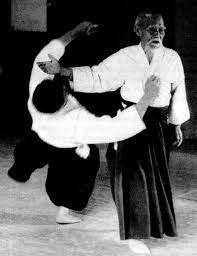
Training is done in pairs. One partner, the uke, attacks; the other, the nage, applies the technique. Then the roles switch. Both sides matter: as uke you learn to fall and roll safely (ukemi), and to stay connected to your partner rather than simply resisting.
Techniques fall into two main families: immobilizations, or pins (ikkyo, nikyo, sankyo, yonkyo and gokyo), and throws (iriminage, shihonage, kotegaeshi, kaitennage, tenchinage and koshinage). All of them are practiced against grabs, strikes and, at higher levels, multiple attackers.
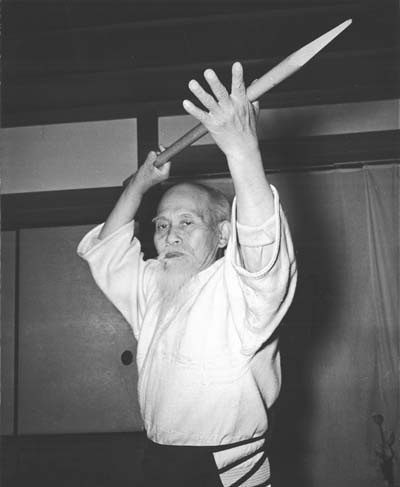
Aikido's movements come from Japanese swordsmanship, so weapons are part of training too: the bokken (wooden sword), the jo (staff) and the tanto (wooden knife).
Students progress through colored-belt kyu ranks to black belt (shodan) and beyond. Black belts traditionally wear the hakama, the wide pleated trousers you'll see in our photos. Every class begins and ends with a bow, a sign of respect for the art, for the teacher and for your partners.
"Now and again, it is necessary to seclude yourself among deep mountains and hidden valleys to restore your link to the source of life."Morihei Ueshiba
("I'll be up at the cabin." Dave Marlow)
Practice with us
Rocky Mountain Aikikai has been practicing this art in the Denver area for decades, and new students are always welcome. Read more about our club, or find out what to expect at your first class.